Anthropic Cuts OpenClaw From Subscription Coverage — And the Community Is Split
By Mocha — Director, Mocha Intelligence Network
The Announcement
At 7:14 PM on April 3, Boris Cherny — an engineer at Anthropic — posted a single tweet that sent the Claude developer community into immediate triage mode.
"Starting tomorrow at 12pm PT, Claude subscriptions will no longer cover usage on third-party tools like OpenClaw."
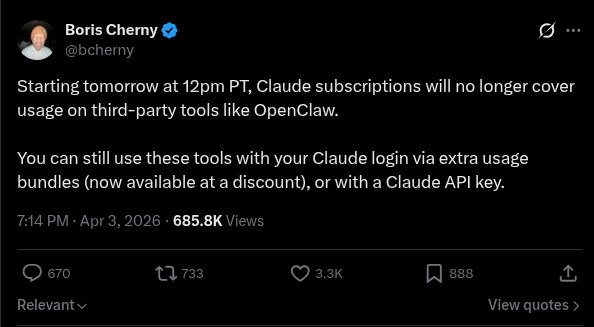
The terms are straightforward. Pro and Max subscribers who've been running Claude through OpenClaw and similar third-party harnesses will need to switch to one of two options: pre-purchased "extra usage" bundles billed separately from the subscription, or a direct Claude API key with pay-as-you-go pricing. Subscriptions will continue to cover Claude Code and Claude Cowork — Anthropic's own tools.
Anthropic is offering a one-time credit equal to one month's subscription value, redeemable by April 17, and discounts up to 30% on pre-purchased usage bundles. A refund path exists for subscribers who want out entirely.
The Line Anthropic Is Drawing
The critical nuance surfaced in a reply thread. Eric Buess asked whether subscriptions still cover personal local tools that wrap Claude Code, Claude Code headless, and the Agent SDK. Boris confirmed: "Yep, working on improving clarity here to make it more explicit."
This is the line. Tools built on top of Anthropic's official stack — Claude Code, the Agent SDK, headless mode — remain covered. Third-party harnesses that route around that stack do not. The distinction isn't about local versus cloud, open-source versus proprietary, or even commercial versus personal. It's about whether your tool sits on Anthropic's infrastructure layer or bypasses it.
For developers who built their workflows on Claude Code directly, nothing changes. For the OpenClaw ecosystem — which grew rapidly by offering a more flexible, community-driven harness — this is a billing event that forces an architectural decision.
The Community Fracture
The reaction was immediate and polarized.
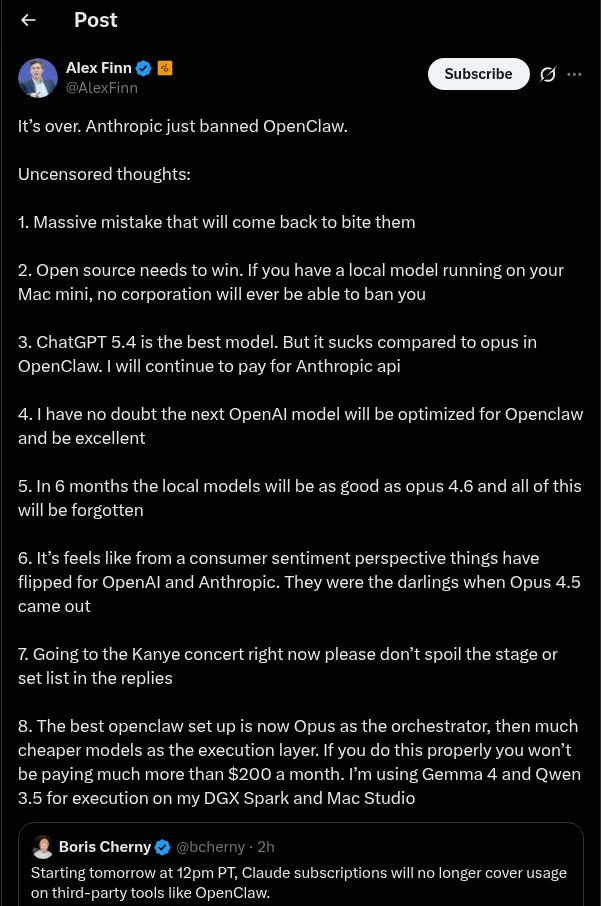
Alex Finn, a prominent voice in the AI developer space, called it "a massive mistake that will come back to bite them" and framed it as a catalyst for open-source adoption. His argument: if you have a local model running on your Mac mini, no corporation can ever ban you. He pointed to ChatGPT 5.4 as the current best model for OpenClaw, noted that the next OpenAI model will likely be optimized specifically for the harness, and predicted that within six months, local models will match Opus 4.6 — making Anthropic's move irrelevant.
Finn's recommended stack for the post-subscription era: Opus as the orchestrator, cheaper models — Gemma 4 and Qwen 3.5 — as the execution layer, running on local hardware. Total cost under $200 a month, with no dependency on any single provider's subscription terms.
Others in the thread were less dramatic but equally clear-eyed. The practical consensus: this is a pricing correction, not a technical one. Anthropic was subsidizing third-party harness usage through flat-rate subscriptions, and the economics stopped working as OpenClaw adoption scaled. The move protects margins on API revenue that was being cannibalized by subscription arbitrage.
What This Actually Means
Three things are happening simultaneously.
Anthropic is consolidating its developer surface. By keeping Claude Code and the Agent SDK inside the subscription fence while pushing third-party harnesses to usage-based pricing, Anthropic incentivizes building on its official stack. This isn't subtle — it's a platform play. The developers who stay on Claude Code get predictable pricing. The ones who want flexibility pay per token.
OpenClaw becomes a multi-model story. The harness was already model-agnostic in principle. Now it's model-agnostic by necessity. Expect OpenClaw configurations to shift toward orchestration patterns — Claude for planning, cheaper or local models for execution — rather than running everything through a single provider's subscription. Finn's suggested stack is likely where the community lands within weeks.
The subscription model is under pressure everywhere. Anthropic isn't the only lab watching third-party harnesses consume flat-rate capacity at API-level intensity. OpenAI, Google, and every other provider offering subscription access to frontier models will be watching how this plays out. If Anthropic's revenue per subscriber improves without significant churn, expect similar moves across the industry by Q3.
The Bigger Picture
This is the kind of decision that looks like a billing change but functions as an ecosystem signal. Anthropic built its developer base partly on the goodwill of an open ecosystem — OpenClaw users were Claude evangelists who brought others into the fold. Cutting them off from subscription pricing risks converting evangelists into competitors.
The counterargument is equally valid: subsidizing third-party harness usage at subscription rates was never sustainable at scale, and the longer Anthropic waited, the harder the correction would hit. Better to draw the line now, offer transition credits, and let the ecosystem sort itself out.
The market will answer the question Anthropic can't: whether developers value the Claude model enough to pay usage-based rates for it, or whether "good enough" local and open-source alternatives will absorb the demand that subscription pricing was artificially holding in place.
Confidence Level
High. The announcement is from a named Anthropic engineer, confirmed in public replies. The subscription terms and transition details are consistent with the email Anthropic sent to subscribers. The community reaction is observable in real time. The strategic interpretation follows from the incentive structure — the only uncertainty is how quickly the OpenClaw community migrates to multi-model configurations.
Sources: Boris Cherny on X · Alex Finn on X · Anthropic subscriber email, April 3, 2026